Showing posts with label Jordan. Show all posts

Friday, July 27, 2007

The Arab League in Israel?

"Wednesday's visit was the first by Arab League representatives to promote their peace plan," remarked an article in al-Jazeera.

The author was referring to a trip by the Egyptian and Jordanian foreign ministers to the Jewish State, where they met with the Israeli Prime Minister, foreign and defense ministers, and president. The purpose of the trip was to promote the Arab League's Saudi Peace Initiative for a resolution of the Arab-Israeli conflict.

Mark Regev, Israel's foreign ministry spokesman, agreed with al-Jazeera over the nature of the visit: “This is the first time that a delegation is coming here under the auspices of the Arab League.’’

But Amr Moussa, the Secretary General of the Arab League, vigorously denied that the foreign ministers represented his organization: "They are not acting under the banner of the Arab League. They represent two Arab countries that for certain circumstances entered into peace accords and official diplomatic relations."

So what's the fuss about? Why would Moussa offer such a fervent repudiation of any connection between the ministers' mission and the Arab League?

The answer, it seems to me, is that old animosities die hard. Though the League was created in 1945, in 1944 representatives from Egypt, Syria, Jordan, Iraq, and Lebanon gathered to discuss the future institution. The result was the Alexandria Protocol, which spelled out the goals of the Arab League.

One of those goals was to end Jewish immigration into what was then British Mandate Palestine. Later, shortly after the Arab League was finalized, the League passed a resolution that stated, "Jewish products and manufactured goods shall be considered undesirable to the Arab countries" and that all Arab "institutions, organizations, merchants, commission agents and individuals" must "refuse to deal in, distribute, or consume Zionist products or manufactured goods."

Since then--when the leaders of Arab League member states weren't calling for the Jews to be thrown in the sea, or denouncing Israel at the U.N., or supporting groups that kill Israeli civilians--the League has tried to ignore Israel. Pretend it doesn't exist, that it is not part of the region.

But lately there have been forces in the Middle East that can't be ignored: the rise of both al-Qaeda and Iran. Though Saudi Arabia once thought it could contain al-Qaeda, the terrorist organization has perpetrated attacks throughout the Middle East, including within Saudi territory. And Iran--whose Persian, Shi'ite version of Islam is an anathema to most Arab countries--has grown increasingly bellicose.

In order to counter these forces, and ease internal tensions, Saudi Arabia came up with a plan that was approved by the Arab League in 2002 and reaffirmed in 2006. The Saudi Peace Initiative calls for full Arab recognition of Israel in return for 1) Israeli withdrawal from the West Bank, the Gaza Strip, and east Jerusalem; 2) the creation of a Palestinian State; and 3) a just solution to the Palestinian refugee problem in accordance with U.N. Resolution 194 (which the Arab public takes to mean that Palestinians should be allowed to resettle in Israel).

The Arab League expects Israel to carry out its obligations before gaining diplomatic recognition from the Arab states. So even though the League has certified the Initiative and authorized the Jordanian and Egyptian foreign ministers to speak to Israel in order to promote it, the Arab League bristles at any suggestion that it is dealing with the "Zionist regime."

If it truly envisions peace between Israel and its neighbors, the Arab League must end these petty denials. This way, Israel and the international community will know that the League desires a friendly, safe, and prosperous future more than it dwells on past hostilities.

Read More......

Sunday, July 15, 2007

Weekend News Wrapup- 7/15/07

A Summary of Interesting Stories throughout the Middle East

Israel and the Palestinian Territories
THE Foreign Ministers of Egypt and Jordan have postponed their trip to Israel until July 25th. The ministers had planned to visit Israel this past week to discuss the Saudi Peace Initiative, which envisions full Arab recognition of Israel in return for Israeli withdrawal from all of Gaza, West Bank, and East Jerusalem; the implementation of a Palestinian Right to Return; and the creation of a Palestinian state. Israel has accepted the Saudi initiative with reservations: 1) it will not grant a Right of Return to Israel itself, as that would lead to the demographic destruction of Israel as a Jewish State (though it supports a Right of Return to a future Palestinian State in the West Bank & Gaza); and 2) all of Jerusalem is Israel's eternal and undivided capital.

The postponement of the trip comes as Israel and the Arab League publicly voice their disagreement over the nature of the delegation. The Arab League had appointed Egypt and Jordan to discuss the Saudi Peace Initiative with Israel. Egypt and Jordan then announced that their Foreign Ministers would visit Israel to discuss the plan. Israel subsequently heralded the ministers' trip as the first time that the Arab League would send an official mission to the Jewish State. But the Secretary General of the Arab League balked at that description, stating that the ministers were only representing the governments of Egypt and Jordan. He further remarked, "The Arab League has no relation with Israel."

PALESTINIAN Authority ("PA") Chairman Mahmoud Abbas has confirmed PA Prime Minister Salam Fayyad as head of a care-taker government. Fayyad had been serving as leader of an emergency government since Abbas dismissed Hamas ministers following their bloody coup in Gaza. Hamas spokesmen have deemed Fayyad's government "illegal" because, according to the PA constitution, the government must be confirmed by the PA parliament. The parliament, however, has been paralyzed due to Hamas' refusal to stand down in Gaza, Israel's imprisonment of half of Hamas members of parliament, and Abbas' refusal to allow his Fatah party to meet with members of Hamas.

ELDER statesman Shimon Peres has been sworn in as Israel's ninth president. Shimon Peres has been associated with each stage of Israel's history: he has served in almost every ministry since the founding of the state, including as prime minister; he was the architect of Israel's nuclear program and policy; and he received the Nobel Peace Prize in 1994 along with Yitzhak Rabin and Yasser Arafat for his work in attempting to bring peace between Israel and its neighbors. Though the presidency is largely ceremonial (somewhat akin to the monarchy in Britain), Peres is an internationally respected figure and will bring much-needed positive attention to the Jewish State.

Lebanon
REPRESENTATIVES from 14 Lebanese parties have met in France in an attempt to ease political deadlock within the Arab state. Included in the meeting are delegates from Hezbollah, an organization that many Western and Arab countries view as perpetuating terrorism and instability.

Following the 2006 war between Israel and Hezbollah, the Shi'ite organization briefly had a wide following among Lebanese for its perceived victory over Israel. But it has since been widely criticized for starting the conflict when it kidnapped two Israeli soldiers. Hundreds of Lebanese citizens died, and there were millions of dollars worth of damage because Hezbollah based its military operations in civilian areas.

Furthermore, Hezbollah is criticized for attempting to block the international tribunal investigating the murder of former Lebanese Prime Minister Rafik Hariri; for walking out of the Lebanese government and helping to block the convening of sessions of parliament; and for holding the interests of Syria and Iran above those of Lebanon.

Iran
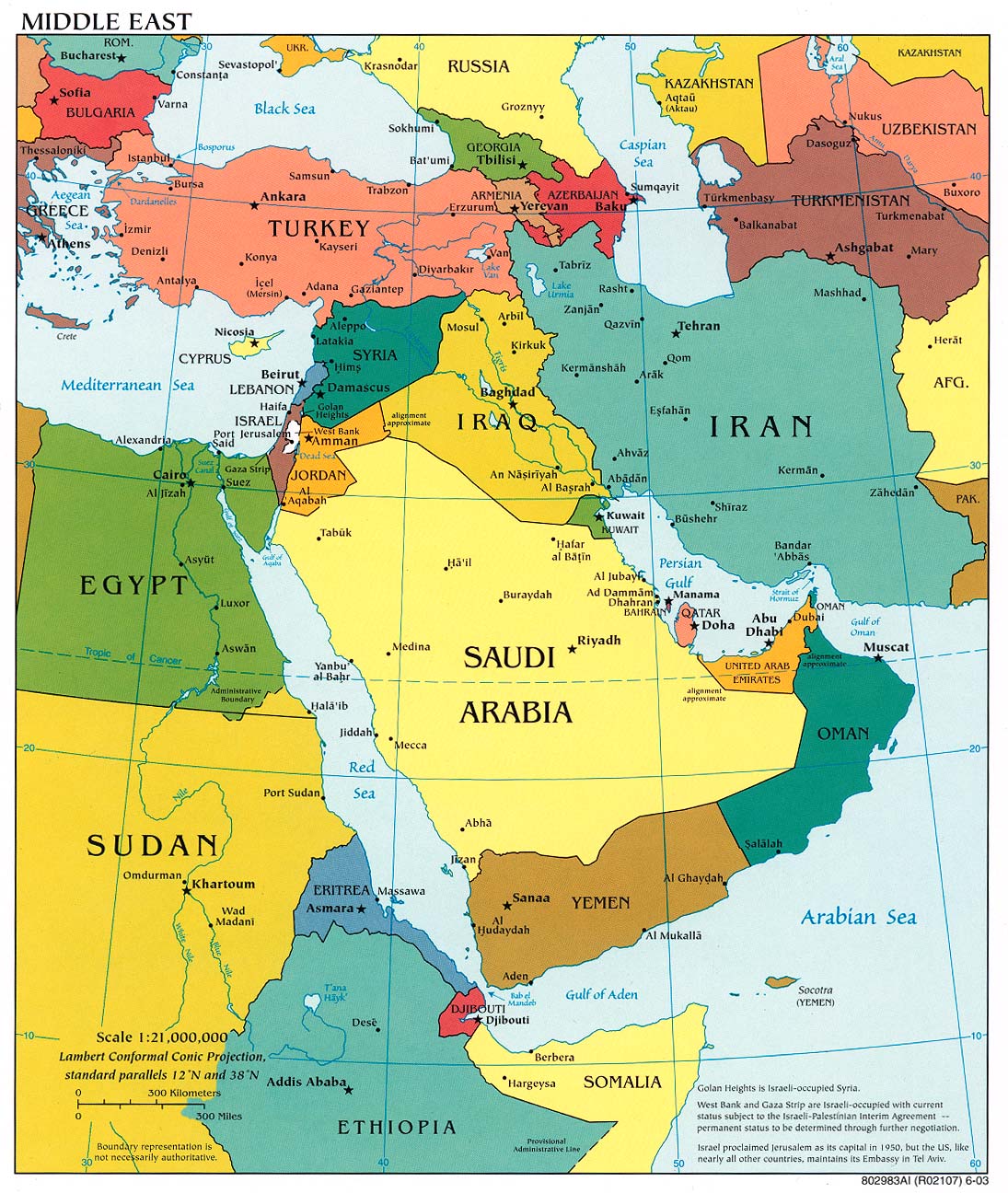
AN Iranian article claiming that the Arab Kingdom of Bahrain is Iranian territory has caused fury around the Arab world (Click here for a regional map of Bahrain). Hossein Shariatmadari, a close confidant of Iranian Supreme Leader Ayatollah Ali Khameini, wrote that "public demand in Bahrain is the reunification of this province with its motherland, the Islamic Iran." The foreign minister of Iran has since traveled to Bahrain in order to quell tensions.

Historically there has been friction between Iran, a Farsi-speaking majority Shi'ite state, and Bahrain, an Arabic-speaking Sunni-led country. In the 1970's Iran laid claim to Bahrain, but the then British protectorate instead voted for independence. In recent times, Arab states of the Persian Gulf and throughout the Mideast have looked at Iran's growing influence and nuclear program with suspicion.

Citizens of Bahrain have gathered in front of the Iranian embassy in protest. Furthermore Egypt, the most populous Arab state, has railed against Shariatmadari's statements. So has the chief of the Gulf Cooperation Council, of which Bahrain is a member along with Saudi Arabia, Kuwait, Oman, Qatar, and the United Arab Emirates.

Read More......

Sunday, July 8, 2007

Weekend News Wrapup- 7/8/07

A Summary of Interesting Stories throughout the Middle East

Israel & the Palestinian Territories
FOR the first time, representatives of the Arab League will make an official visit to Israel this coming Thursday. The foreign ministers of Egypt and Jordan--appointed by the Arab League to promote the Saudi Peace Initiative--will meet with Israeli Prime Minister Ehud Olmert, Foreign Minister Tzipi Livni, and Defense Minister Ehud Barak.

The Saudi Initiative calls for Israel to withdraw from all lands it captured in the 1967 Six Day War, including East Jerusalem, and implement a Palestinian right to return in exchange for full Arab recognition of Israel. PM Olmert has welcomed the plan, though has reservations on a pull back from East Jerusalem (which is part of Israel's capital) and resettlement of Palestinians in Israel proper.

The Arab League has traditionally been hostile to Israel, so this visit will indeed be a historic occasion. Upon its creation in 1945, the organization resolved to boycott all Jewish products originating from what was then British Mandate Palestine. The Arab League expanded the boycott when Israel gained independence in 1948. To this day, most Arab League member states continue to boycott products and services from Israel, and some states refuse to do business with any company that engages with Israel.

ISLAMIC Jihad and Hamas claimed responsibility for firing several Kassam rockets into Israel from the Gaza Strip. The rockets caused no casualties, though a university building sustained damages.

PALESTINIAN lawyers have questioned the constitutionality of Palestinian Authority ("PA") President Mahmoud Abbas' decision to appoint a new government without parliament's approval. Abbas tapped former World Bank official Salam Fayyad to head the government after firing Hamas representatives because of the violent coup staged in Gaza.

The Palestinian lawyers, who helped draft the constitution which was implemented in 2002, claim that Abbas was permitted to fire the Hamas lawmakers from the cabinet, but could not appoint a new government. The lawyers further stated that Abbas could not suspend parts of the constitution. Representative of Abbas responded that the PA is in a state of emergency, and thus Abbas' word is law.

Egypt
EGYPTIAN authorities seized over a ton of explosives in the Sinai Peninsula, in an area approximately 100 km from the Gaza border. Palestinian militants often use the Gaza border to smuggle in weapons and explosives for internecine fighting and to commit terrorist acts against Israel.

Lebanon
LEBANESE soldiers raided an apartment in Tripoli and seized members and weapons from an al-Qaeda inspired terrorist group. Fatah al-Islam (not to be confused with the mainstream Palestinian group Fatah) has for over a month been in armed battle with Lebanese forces. The group has used Palestinian refugee camps in Lebanon as bases, though members from countries throughout the Arab world have been found. Lebanese Prime Minister Fouad Siniora has vowed to arrest or kill members of Fatah al-Islam, which has claimed responsibility for several bombings around Lebanon. Some suspect that the group is being directed by Syria, and its purpose is to destabilize Siniora's anti-Syrian government.

Read More......

Tuesday, June 26, 2007

On Bolstering Abbas

In a historic meeting between the leaders of Israel, the Palestinian Authority, Jordan, and Egypt, Israeli Prime Minister Ehud Olmert has promised to transfer $35o million to Palestinian Authority President Mahmoud Abbas. He also promised to release 250 Palestinian prisoners as a show of good faith. This announcement comes shortly after the United States and the European Union decided to lift the economic embargo against the Palestinian Authority, a result of Abbas sacking the Hamas government.

King Abdullah of Jordan and Egyptian President Hosni Mubarak voiced their support for Abbas. The Quartet of Middle East Mediators (the U.S., U.N., E.U., and Russia) met today in Jerusalem, suggesting that they believe Israel can work with Abbas as a partner for peace. The Quartet has not quashed rumors that outgoing British Prime Minister Tony Blair will be its new envoy, further suggesting the group sees new momemtum for a peace process.

So is all of this faith that the international community (including Israel) has in Abbas misplaced? In previous posts (From the Horse's Mouth, They're Wrong) I have written how Abbas and his Fatah party are just as bad, if not worse, than Hamas because Abbas says all the right things but has no power or will to implement hard decisions. He gives hope to the Israelis, Palestinians, and international community yet always disappoints, leading to dispair and worse violence.

But shouldn't Israel and the international community at least try to work towards a peace settlement with Abbas, the "voice of moderation?" My mind and my gut says absolutely not, but the remnants of my bleeding heart liberalism past says perhaps. However, there must be strict monitering of any money, weapons, or prisoners released to Abbas & Fatah. Furthermore, Abbas & Fatah must meet certain benchmarks in order to show that they are truly partners. These include:

  • Disbanding and disarming all non-state militias, including Fatah-related militias such as the al-Aqsa Martyrs Brigade and Tanzim.
  • Creating and enforcing a zero tolerance policy for crime and corruption.
  • Ending all media incitement against Israel.
Once Abbas takes these steps, he will have proven that he is willing to make and implement difficult decisions. Only then can Israel and the international community take any further actions to bolster Abbas and work toward peace and a Palestinian state. If Abbas fails to take these steps, which he likely will, then Israel and all those who desire for peace must look for a different path.

Read More......