Showing posts with label Iran. Show all posts

Friday, January 14, 2011

Tampa City Council Candidate Discusses Link Between Local Pension Funds And Iran

Seth Nelson is a friend, a fellow family law attorney, and a candidate for Tampa City Council's District 3 city-wide seat.  Seth recently wrote an article for Tampa Bay Online which discusses how international fund managers for the Tampa General Employee Pension Fund invest dollars into companies that do business with Iran.  Below is an excerpt:


America and its international allies have imposed sanctions to hamper Iran's ability to attract investment in its energy sector, which persists in enriching uranium and developing nuclear technology. Tampa cannot allow its sizable pension to support companies that undermine America's efforts.
The pension board's consultant asked me whether I believed there would be any impact on Iran by changing Tampa's guidelines. Of course, we should do what's right even if doing so were only symbolic. But in this case doing what's right will indeed have an impact because every dollar matters.
You can learn more about Seth Nelson and his campaign at http://www.sethnelson2011.com.

Read More......

Monday, September 24, 2007

Iran's Take on Ahmadinejad's Columbia U. Speech

As many media outlets covered the Iranian President's speech at Columbia University, so did the Islamic Republic News Agency (IRNA). This organization is Iran's official mouthpiece, funded by the Ministry of National Guidance, and had a somewhat different take on Ahmadinejad's visit. Here is the text of the IRNA article:

Despite entire US media objections, negative propagation and hue and cry in recent days over IRI President Mahmoud Ahmadinejad's scheduled address at Colombia University, he gave his lecture and answered students questions here on Monday afternoon.

On second day of his entry in New York, and amid standing ovation of the audience that had attended the hall where the Iranian President was to give his lecture as of early hours of the day, Ahmadinejad said that Iran is not going to attack any country in the world.

Before President Ahamadinejad's address, Colombia University Chancellor in a brief address told the audience that they would have the chance to hear Iran's stands as the Iranian President would put them forth.

He said that the Iranians are a peace loving nation, they hate war, and all types of aggression.

Referring to the technological achievements of the Iranian nation in the course of recent years, the president considered them as a sign for the Iranians' resolute will for achieving sustainable development and rapid advancement.

The audience on repeated occasion applauded Ahmadinejad when he touched on international crises.

At the end of his address President Ahmadinejad answered the students' questions on such issues as Israel, Palestine, Iran's nuclear program, the status of women in Iran and a number of other matters.


It seems that the IRNA missed parts of the speech, and lied about other parts. First off, though Ahmadinejad did receive a polite applause when he began his speech, he certainly did not receive a standing ovation. In fact, Columbia U.'s president received much louder applause during his critical intro of the Iranian president. This may seem like a petty point, but it illustrates how skewed IRNA reporting is. It wants to project it's leader as taming the lion that is the American public.

Which brings me to the second point: There is absolutely no mention of the blistering introduction he received from Lee Bollinger. Almost all other media outlets, including a story from al Jazeera, highlighted such instant classics as "Mr President, you exhibit all the signs of a petty and cruel dictator." But I guess IRNA wasn't watching C-SPAN during the intro.

Third, IRNA is correct that Ahmadinejad took on many different topics from students. But I find it interesting that the news agency doesn't mention that the President took on homosexuality in Iran. It mentions Israel, Palestine, nuclear programs, and women, but not homosexuality. Maybe the topic wasn't covered because it isn't really that pertinent, as Ahmadinejad clearly stated that "
In Iran, we don't have homosexuals like in your country." More likely the topic isn't mentioned because that statement prompted laughs and boos from the audience.

I think IRNA needs to pay more attention to its leader's speeches. Or at least watch more C-SPAN.


Read More......

Sunday, August 5, 2007

Weekend News Wrapup- 8/5/07

Israel and the Palestinian Territories
ISRAELI Prime Minister Ehud Olmert and PA President Mahmoud Abbas are scheduled to meet in the West Bank city of Jericho on Monday. The two are set to formulate a Declaration of Principles for a final settlement of the conflict. This, in turn, will be used as a basis for talks in a regional summit that U.S. Secretary of State Condaleeza Rice has planned for November.

There are several issues, beside final boundaries and a Palestinian "right of return," that complicate efforts for a final settlement. The first is that, after Hamas' bloody coup two months ago, Abbas no longer has any control over the Gaza Strip. The second is that Abbas' Fatah party is still seen by Palestinians as weak and corrupt. Its ability to enforce a peace agreement even in the West Bank is questionable. The third is Olmert's poor standing among Israelis. Olmert is less popular in Israel than President George W. Bush is in the United States, and Israelis may not trust him to ensure a fair and comprehensive peace.

OVER 300 members of terrorist groups associated with PA President Mahmoud Abbas have accepted an amnesty deal from Israel. Israel has promised to take these people aligned with Fatah, all located in the West Bank, off of its wanted list in exchange for them turning in their weapons and swearing off attacks on the Jewish State. The amnesty deal is part of a package of gestures that Israel is using to bolster Abbas' standing in the Palestinian territories.

Interestingly, members of Islamic Jihad, an Islamist terrorist group opposed to peace with Israel, have requested to be included in the amnesty. The Islamic Jihad leadership, however, has lambasted the amnesty and reaffirmed its commitment to destroy Israel.

Lebanon
RESIDENTS of the Christian city of Metn have gone to the polls to replace two assassinated Members of Parliament. Amin Gemayal, former president of Lebanon and father of one of the slain MP's, is contesting for his son's seat. His opponent is Kamil Khoury. Both candidates are Christian, though Gemayal is associated with the pro-Western government of Prime Minister Sinora while Khoury is aligned with the pro-Syria, Hezbollah-led opposition. The other seat is only being contested by pro-Western politician Mohammed al-Amin Itani.

MP's Pierre Gemayal and Walid Eido were murdered within the last year. Syria is suspected to be behind the slayings.

Iran
IRANIAN President Mahmoud Ahmadinejad has called on Israel to "go somewhere else." He stated that Israel should leave the region and a Palestinian state should crop up in its place. This comes after he has declared that Israel should be "wiped off the map" and hosted a Holocaust-denial conference.

His statement should also be viewed in the context of Iran's nuclear program. Iran has refused to suspend its nuclear activities, which the Islamic Republic has argued is purely for energy production. Western powers, however, are convinced it is also being used to develop a nuclear weapons program.

Read More......

Sunday, July 22, 2007

Weekend News Wrapup- 7/22/07

Israel and the Palestinian Territories
PALESTINIAN Authority President Mahmoud Abbas has apparently made good on his pledge to crack down on Hamas in the West Bank. On Sunday his security services arrested 22 rival Hamas operatives in a 24-hour campaign against the terrorist group. This comes as members of terrorist groups associated with Abbas' Fatah party have pledged to end their attacks on Israel and turned in their weapons in return for being removed from Israel's wanted list. The question remains as to how many individuals have made that pledge, and whether Abbas is willing and able to enforce an end to attacks on Israel from his own party.

Syria
IRANIAN President Mahmoud Ahmadinejad met in Damascus this past week with Syrian President Bashar al-Assad and Hezbollah leader Hassan Nasrallah. Assad and Ahmadinejad reportedly struck a deal where Iran would fund for Syria $1 billion worth of advance weapons--including fighter jets, tanks, and missiles--and aid in Syrian nuclear and chemical weapons research. In return, Assad reportedly promised not to seek peace with Israel. Iran has denied the deal.

Turkey
EXIT Polls in Turkey's parliamentary elections show the religious-oriented Justice and Development Party [which goes by its Turkish initials "AKP"] won in a landslide against strictly secular parties. Preliminary polls give AKP 51.6%, while left-leaning Republican People's Party ["CHP"] won 15.2% and far-right National Action Party ["MHP"] won 13.7%.

The AKP is more accurately compared to the religious right in the U.S. rather than other "Islamist parties" such as Hamas in the Palestinian territories or Hezbollah in Lebanon. It is considered pro-business, and has overseen annual GDP growth of 7%. It also has worked to conform Turkish laws to fit European Union standards. But it wishes to permit more public expressions of religion in Turkey, such as allowing women to wear head-coverings in public universities or allowing politicians to publicly proclaim their faith. Kemal Ataturk, the founder of modern Turkey, imposed a strict separation of Mosque and State.

In recent months there has been tension between the current AKP government and the military, which considers itself the guardian of Turkish secularism. The military has initiated four coups since the 1960's; the latest occurred in 1997 when Prime Minister Necmettin Erbakan was pressured to step down due to his militant Islamist views. The AKP has much milder views than Erbakan, but the military has accused the party of undermining Turkey's secular character.

In Turkish elections, voters select parties rather than candidates. The party with the most votes wins the most seats in the 550 member parliament. A party must receive at least 10% of the vote to gain seats. If a party takes more than 50% of the seats, they form the government; if no party receives an absolute majority of the seats, several parties may form a coalition government.

Read More......

Sunday, July 15, 2007

Weekend News Wrapup- 7/15/07

A Summary of Interesting Stories throughout the Middle East

Israel and the Palestinian Territories
THE Foreign Ministers of Egypt and Jordan have postponed their trip to Israel until July 25th. The ministers had planned to visit Israel this past week to discuss the Saudi Peace Initiative, which envisions full Arab recognition of Israel in return for Israeli withdrawal from all of Gaza, West Bank, and East Jerusalem; the implementation of a Palestinian Right to Return; and the creation of a Palestinian state. Israel has accepted the Saudi initiative with reservations: 1) it will not grant a Right of Return to Israel itself, as that would lead to the demographic destruction of Israel as a Jewish State (though it supports a Right of Return to a future Palestinian State in the West Bank & Gaza); and 2) all of Jerusalem is Israel's eternal and undivided capital.

The postponement of the trip comes as Israel and the Arab League publicly voice their disagreement over the nature of the delegation. The Arab League had appointed Egypt and Jordan to discuss the Saudi Peace Initiative with Israel. Egypt and Jordan then announced that their Foreign Ministers would visit Israel to discuss the plan. Israel subsequently heralded the ministers' trip as the first time that the Arab League would send an official mission to the Jewish State. But the Secretary General of the Arab League balked at that description, stating that the ministers were only representing the governments of Egypt and Jordan. He further remarked, "The Arab League has no relation with Israel."

PALESTINIAN Authority ("PA") Chairman Mahmoud Abbas has confirmed PA Prime Minister Salam Fayyad as head of a care-taker government. Fayyad had been serving as leader of an emergency government since Abbas dismissed Hamas ministers following their bloody coup in Gaza. Hamas spokesmen have deemed Fayyad's government "illegal" because, according to the PA constitution, the government must be confirmed by the PA parliament. The parliament, however, has been paralyzed due to Hamas' refusal to stand down in Gaza, Israel's imprisonment of half of Hamas members of parliament, and Abbas' refusal to allow his Fatah party to meet with members of Hamas.

ELDER statesman Shimon Peres has been sworn in as Israel's ninth president. Shimon Peres has been associated with each stage of Israel's history: he has served in almost every ministry since the founding of the state, including as prime minister; he was the architect of Israel's nuclear program and policy; and he received the Nobel Peace Prize in 1994 along with Yitzhak Rabin and Yasser Arafat for his work in attempting to bring peace between Israel and its neighbors. Though the presidency is largely ceremonial (somewhat akin to the monarchy in Britain), Peres is an internationally respected figure and will bring much-needed positive attention to the Jewish State.

Lebanon
REPRESENTATIVES from 14 Lebanese parties have met in France in an attempt to ease political deadlock within the Arab state. Included in the meeting are delegates from Hezbollah, an organization that many Western and Arab countries view as perpetuating terrorism and instability.

Following the 2006 war between Israel and Hezbollah, the Shi'ite organization briefly had a wide following among Lebanese for its perceived victory over Israel. But it has since been widely criticized for starting the conflict when it kidnapped two Israeli soldiers. Hundreds of Lebanese citizens died, and there were millions of dollars worth of damage because Hezbollah based its military operations in civilian areas.

Furthermore, Hezbollah is criticized for attempting to block the international tribunal investigating the murder of former Lebanese Prime Minister Rafik Hariri; for walking out of the Lebanese government and helping to block the convening of sessions of parliament; and for holding the interests of Syria and Iran above those of Lebanon.

Iran
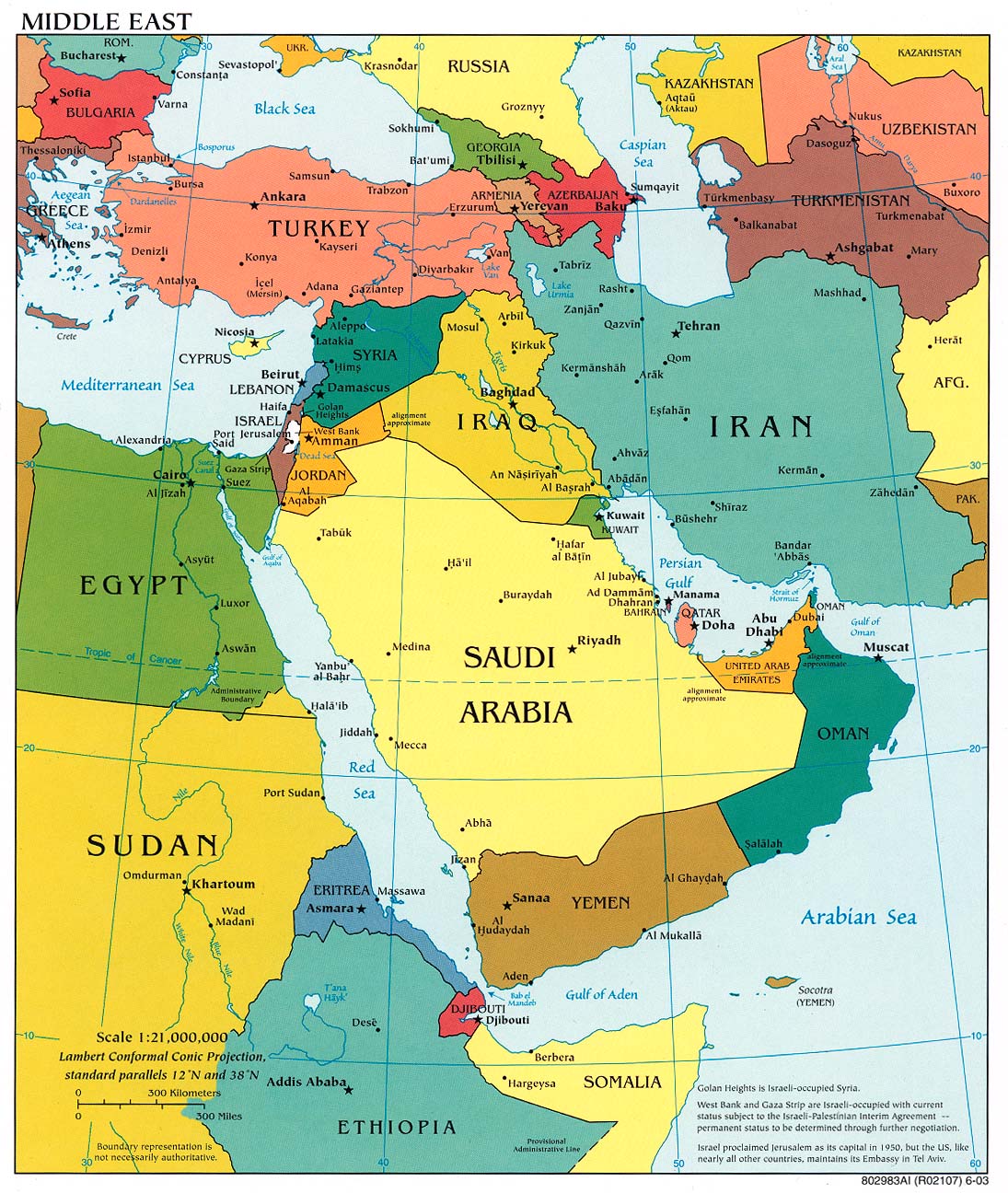
AN Iranian article claiming that the Arab Kingdom of Bahrain is Iranian territory has caused fury around the Arab world (Click here for a regional map of Bahrain). Hossein Shariatmadari, a close confidant of Iranian Supreme Leader Ayatollah Ali Khameini, wrote that "public demand in Bahrain is the reunification of this province with its motherland, the Islamic Iran." The foreign minister of Iran has since traveled to Bahrain in order to quell tensions.

Historically there has been friction between Iran, a Farsi-speaking majority Shi'ite state, and Bahrain, an Arabic-speaking Sunni-led country. In the 1970's Iran laid claim to Bahrain, but the then British protectorate instead voted for independence. In recent times, Arab states of the Persian Gulf and throughout the Mideast have looked at Iran's growing influence and nuclear program with suspicion.

Citizens of Bahrain have gathered in front of the Iranian embassy in protest. Furthermore Egypt, the most populous Arab state, has railed against Shariatmadari's statements. So has the chief of the Gulf Cooperation Council, of which Bahrain is a member along with Saudi Arabia, Kuwait, Oman, Qatar, and the United Arab Emirates.

Read More......

Monday, July 9, 2007

Al-Qaeda Issues Ultimatum to Iran

According to an article in al-Jazeera, al-Qaeda in Iraq threatened to wage war against Iran if the country continued to support Iraq's Shi'a community.

Abu Omar al-Baghdadi, the leader of the Islamic State in Iraq (which is affiliated with al-Qaeda in Iraq) stated in an audio tape:

We are giving the Persians, and especially the rulers of Iran, a two-month period to end all kinds of support for the Iraqi Shia government and to stop direct and indirect intervention ... otherwise a severe war is waiting for you.
He further warned Arab countries from doing business with Iran.

The audio tape has not been independently verified. Moreover, the U.S. military previously stated that they killed al-Baghdadi in May. But a scenario of al-Qaeda attacking Iran is by no means far-fetched.

Most historians, at least in the U.S., credit the 1979-1989 Soviet invasion of Afghanistan for leading to the creation of al-Qaeda. They claim that Muslims were called to jihad against the "atheist invader," and the U.S. supported these fighters with money and arms.

This may be part of the story of how al-Qaeda was created, but it is not the complete story. The year 1979 also saw the creation of the Islamic Republic of Iran. According to Vali Nasr in his book "The Shia Revival," this event was one of the principal steps in the spread of al-Qaeda ideology. But not in the way most Americans might think.

Iran is a predominantly Shi'ite country. They have beliefs that conflict with Sunni interpretations of Islam. For example, they believe that the successors to their Prophet Muhammed should have been members of Muhammed's family, rather than learned individuals chosen by a group of scholars (as was the case). The Shi'a also believe that one day the Twelfth Imam, a descendant of Muhammed and a messiah-like figure, will bring about the end of times. Most Sunnis do not believe in the Twelfth Imam. In addition, the Shi'a build shrines to revered figures in their history, whereas many Sunnis consider such acts a form of idolatry.

Grand Ayatollah Khomeini, the leader of the new Islamic Republic of Iran, promised to spread the ideology and influence of Shi'a Islam. He succeeded in many places including Iraq, countries around the Persian Gulf, and Lebanon (where his crowning success was the development of Hezbollah).

In response, Saudi Arabia greatly increased it funding for madrasahs, or schools. These institutions promoted Wahabism, an extreme form of Islam that has no tolerance for anyone perceived to defame Sunni traditions. Shi'ites from the beginning were a target of Wahabi wrath.

To counter the rise of Iran and its proxies, Saudi Arabia fully supported the spread of Wahabi militarism. And Wahabi ideology forms the backbone of al-Qaeda.

Since the U.S. intervention, many in the Shi'a community in Iraq, led by individuals such as Muqtada al-Sadr and backed by Iran, have fought against Sunni groups including al-Qaeda in Iraq. Iran has further supported the Iraqi government, which some view as anti-Sunni. So it would not be surprising if in the near future we see al-Qaeda declare an all out war against Iran.


Read More......

Sunday, July 1, 2007

Weekend News Wrapup- 7/1/07

A Summary of Interesting Stories throughout the Middle East

Israel & the Palestinian Territories
ISRAEL has transferred $118 million to the new Palestinian government. These custom duties have been collected by Israel on behalf the Palestinian Authority ["PA"] under a 1990 agreement. Following the 2006 Palestinian election where Hamas won the majority of parliament seats & formed the government, Israel has refused to transfer the funds for fear that they may be used for terrorist attacks. But now that Hamas is no longer part of the official Palestinian government, Israel has agreed to release the funds in installments.

FORMER Israeli Prime Minister Ehud Barak--who is currently the defense minister, head of the Labor party, and prospective candidate for the prime ministership--has announced that he will pull Labor out of the government if current Prime Minister Ehud Olmert does not resign by September or October. The Winograd committee, set up to review Israel's performance against Hezbollah in the 2006, is expected to come out with its final report at that time. The preliminary report that was released earlier this year pinned much of the blame on Olmert for poorly planning, executing, and reviewing war strategies. If Barak pulls Labor out of the government, Olmert will either have to find new coalition partners to maintain a majority in the Knesset [parliament], or call new elections, in which case his Kadima party will likely lose many--if not most--of its Knesset seats.

HAMAS stated Saturday that it would attack international peace-keeping forces if they enter the Gaza Strip. Hamas, which defeated PA President Mahmoud Abbas' security & militia forces in a bloody coup three weeks ago, now has effective control over all of the Gaza Strip. The organization's recent statements were in reaction to Abbas' proposal that international forces enter Gaza to ensure a stable environment for elections and reunification with the West Bank.

Egypt
EGYPT has stated that it will resume efforts to negotiate a deal between Israel and Hamas that would lead to the release of Israeli Cpl. Gilad Shalit. Hamas and other terrorist groups kidnapped Shalit in a cross-border raid a year ago. Egypt, which has served as a mediator between Hamas and Israel, ended all efforts when Hamas took over Gaza three weeks ago. Hamas has demanded the release of hundred of Palestinians in Israeli jails, many of whom have been convicted of murdering civilians in terrorist attacks.

Lebanon
LEBANESE soldiers killed four Palestinians and wounded 30 during a protest demonstration, in response to Palestinian throwing stones at the soldiers. The Palestinians demanded to return to their homes in the Nahr al-Bared refugee camp, where many have lived since Israel's 1948-49 War of Independence. The Palestinians had fled the camp when Islamist extremists used the area as a base to carry out terrorist bombings, which led to the Lebanese army laying siege to the camp a month and a half ago. Since there are still terrorists believed to be holed up in Nahr al-Bared, the Lebanese army has refused to let civilians back in.

Iran
VENEZUELAN President Hugo Chavez reiterated his support for Iran's nuclear program as he met with Iranian President Mahmoud Ahmadinejad on Sunday. Iran is widely believed to be working on a nuclear weapons' program, though officials have insisted that the technology is only for peaceful civilian purposes. Fear of what Iran might do with a nuclear weapon was intensified last year when Ahmadinejad promised to wipe Israel off the map. Chavez appeared in Tehran, described Ahmadinejad as his "ideological brother" and promised to help Iran in its fight against international "imperialism."

Read More......