Showing posts with label Fatah. Show all posts

Sunday, August 5, 2007

Weekend News Wrapup- 8/5/07

Israel and the Palestinian Territories
ISRAELI Prime Minister Ehud Olmert and PA President Mahmoud Abbas are scheduled to meet in the West Bank city of Jericho on Monday. The two are set to formulate a Declaration of Principles for a final settlement of the conflict. This, in turn, will be used as a basis for talks in a regional summit that U.S. Secretary of State Condaleeza Rice has planned for November.

There are several issues, beside final boundaries and a Palestinian "right of return," that complicate efforts for a final settlement. The first is that, after Hamas' bloody coup two months ago, Abbas no longer has any control over the Gaza Strip. The second is that Abbas' Fatah party is still seen by Palestinians as weak and corrupt. Its ability to enforce a peace agreement even in the West Bank is questionable. The third is Olmert's poor standing among Israelis. Olmert is less popular in Israel than President George W. Bush is in the United States, and Israelis may not trust him to ensure a fair and comprehensive peace.

OVER 300 members of terrorist groups associated with PA President Mahmoud Abbas have accepted an amnesty deal from Israel. Israel has promised to take these people aligned with Fatah, all located in the West Bank, off of its wanted list in exchange for them turning in their weapons and swearing off attacks on the Jewish State. The amnesty deal is part of a package of gestures that Israel is using to bolster Abbas' standing in the Palestinian territories.

Interestingly, members of Islamic Jihad, an Islamist terrorist group opposed to peace with Israel, have requested to be included in the amnesty. The Islamic Jihad leadership, however, has lambasted the amnesty and reaffirmed its commitment to destroy Israel.

Lebanon
RESIDENTS of the Christian city of Metn have gone to the polls to replace two assassinated Members of Parliament. Amin Gemayal, former president of Lebanon and father of one of the slain MP's, is contesting for his son's seat. His opponent is Kamil Khoury. Both candidates are Christian, though Gemayal is associated with the pro-Western government of Prime Minister Sinora while Khoury is aligned with the pro-Syria, Hezbollah-led opposition. The other seat is only being contested by pro-Western politician Mohammed al-Amin Itani.

MP's Pierre Gemayal and Walid Eido were murdered within the last year. Syria is suspected to be behind the slayings.

Iran
IRANIAN President Mahmoud Ahmadinejad has called on Israel to "go somewhere else." He stated that Israel should leave the region and a Palestinian state should crop up in its place. This comes after he has declared that Israel should be "wiped off the map" and hosted a Holocaust-denial conference.

His statement should also be viewed in the context of Iran's nuclear program. Iran has refused to suspend its nuclear activities, which the Islamic Republic has argued is purely for energy production. Western powers, however, are convinced it is also being used to develop a nuclear weapons program.

Read More......

Thursday, August 2, 2007

Hamas Confronts Islamic Jihad

In an effort to bolster the group's authority in the Gaza Strip, Hamas forces clashed with militants from Palestinian Islamic Jihad. During the incident, gunmen from Hamas shot one member of Islamic Jihad in the head, and several other members in the legs.

The Incident
Hamas recently enacted a ban against gunfire in public in a bid to bring order to the Gaza Strip. Members of Islamic Jihad eschewed that ban, and unleashed rounds into the air during a wedding celebration. Hamas gunmen confronted the militants and ordered them to stop, but those affiliated with Islamic Jihad refused.

The next day, Hamas militants stormed the homes of members of Islamic Jihad, trading fire and confiscating weapons. At one point, a Hamas member fired a rocket at an Islamic Jihad member's home.

The same day, Hamas gunmen chased Islamic Jihad fighters into a mosque, and then dragged them out. They proceeded to shoot one Islamic Jihad militant in the head, and several in the legs. Other Islamic Jihad members were arrested. After the incident a Hamas spokesman wrote, "We implemented the law."

Traditional Allies have Subtle Differences
What's so interesting about these incidents is that Hamas and Islamic Jihad have traditionally been closely allied. They both have an Islamist agenda, they call for the destruction of Israel, they have cooperated in attacks against Israel, they formed as offshoots of Egypt's Islamic Brotherhood, and they receive funds from Iran.

But there are some subtle differences. First, while Hamas has always given equal priority to attacking Israel and providing social services for poor Palestinians, Islamic Jihad has primarily focused on destroying the Jewish State.

Moreover, though both organizations originally refused to participate in the Palestinian Authority (essentially the Palestinian government) because it was created during the 1990's peace process with Israel, Hamas eventually ran candidates for the PA parliament. In addition, while both groups are Sunni and have ties to Shi'a Iran, Islamic Jihad is much more closely aligned with Iranian/Shi'a practices such as rule by clerics.

Politics and Gang Mentality

These differences, however, don't explain the recent violence. What does explain the violence is politics and gang mentality.

When Hamas and Fatah were battling in Gaza two months ago, Islamic Jihad decided to stay out of the fray. It considered such inter-Palestinian fighting an anathema to its cause and, paradoxically, the group thrived in the the chaos that existed during the Fatah-Hamas unity period. When Hamas routed Fatah and became the masters of Gaza, Hamas felt slighted that it had not received the support of its fellow Islamists.

Moreover, with Hamas now enforcing order, Islamic Jihad has become highly territorial in regards to its weapons and zones of influence. But Hamas has become equally if not more territorial, and sees itself as enforcer of the law in all of Gaza. Thus, as the Bloods and the Crips have squared off brutally to protect their interests, so have Hamas and Islamic Jihad.

Winners and Losers

If Hamas is willing and able to defeat Islamic Jihad as it did Fatah, there will be winners and losers. The first winner, of course, would be Hamas. Not only would it show once again that it is the dominant force in Gaza, but it would also lessen the likelihood of an attack from Israel. As Islamic Jihad has been responsible for most of the constant rocket attacks from Gaza, it has given Israel a ready excuse to invade and retaliate any time it wishes. But if Hamas crushes Islamic Jihad, Israel will be less agitated and Gazans are more likely to live calm lives.

The other winner would be Israel. As mentioned above, the daily barages of rockets would lessen, if not cease. And when there are attacks from Gaza, the Jewish State would have a clearer picture of who perpetrated the attack. Furthermore, as Hamas would be the sole political force in Gaza, it would have to focus on state-building and day-to-day administration rather than attacking Israel.

One loser, clearly, would be Islamic Jihad. It would be humiliated by defeat and lose one of its major bases of operation.

The primary loser, however, would be Fatah. Hamas will have done what Fatah couldn't or refused to do in over a decade of power: impose order. Though Fatah recently has been more successful in disarming opponents in the West Bank, its security forces do not seem to have the determination or discipline to fully enforce its will. Palestinians would compare the relative calm in Gaza to the corrupt and violent situation in the Fatah-controlled West Bank.

Read More......

Friday, July 27, 2007

Fatah General calls Hamas 'Bloodthirsty'

In an article in the Jerusalem Post, a general from Palestinian Authority President Abbas' Fatah party recounted the last days of Hamas' bloody takeover of Gaza. Here are some excerpts:

"We were surrounded by hundreds of Hamas gunmen in our bases and offices in the security zone near the Gaza City beach. I had about 35 men with me and we were planning to fight to the end...

"I knew that I was wanted by Hamas and that's why I decided to fight to the end. I knew that Hamas was going to kill me anyway and that I had nothing to lose. On Thursday night [June 14], hours before Hamas completed its coup, I managed to fire dozens of rocket-propelled grenades at them. I inflicted heavy damages on them. I taught them a lesson that they will never forget.

"But when I finally realized that Hamas's forces were advancing toward our security zone, I decided to leave the area. At around 2 a.m. on Friday morning I ran away toward the Egyptian security delegation's offices on the 10th floor of a tower near my base. I covered my face with a keffiyeh and threw my rifle away.

"Shortly after I entered the Egyptians' office, about 30 Hamas gunmen stormed the area and detained me. They did not care about the fact that this was an office belonging to the Egyptian security forces. They dragged me down to the street, where most buildings and houses were on fire.

"As we stood there, I asked the Hamas people: 'Why don't you execute me and dump my body in the flames?' Actually I begged them to execute me because I knew I was going to be tortured. Before they put me in a jeep, I saw the Hamas gunmen execute several people right in front of me. They were shooting all the detainees. I was sure that one of them was going to shoot me in the head. But they later blindfolded me and took me to a place where I was held for about 12 hours.

"In this place, there were a number of senior security commanders who had also been captured by Hamas. We were all told that we were going to be executed immediately after our interrogation. They asked us many questions and kept us locked in small rooms. We had no idea where we were being held. Some of us were beaten severely."

The general, who spoke on condition of anonymity, was eventually released due to the intervention of a Fatah official close to the Hamas leadership. He was then allowed to escape Gaza and enter the West Bank. Asked if he would return to the Gaza Strip, the general replied:


"If I go back, Hamas will kill me immediately. I'm wanted by them. My wife and children are still there and Hamas has burned my house. I don't know what's going to happen now, but I'm not optimistic. These Hamas people are murderers and bloodthirsty. They are using religion as an excuse to commit crimes even against their own people."

Though the general showed great disdain for Hamas and its bloody coup, he also admitted admiration for their strategy:
"Everything was carefully planned. They were closing in on us from all directions. You could see that they were operating according to a good plan.

"They managed to isolate Khan Yunis from the rest of the Gaza Strip. Then they isolated Rafah and other cities. They even divided Gaza City into separate zones and kept moving ahead."

We will have to see whether Abbas' Fatah forces can similarly execute such strategy against Hamas operatives in the West Bank, while reigning in corruption and random violence perpetrated by militias linked to his own party. So far, things are actually looking promising. More on this later.

END OF ARTICLE

Read More......

Sunday, July 15, 2007

Weekend News Wrapup- 7/15/07

A Summary of Interesting Stories throughout the Middle East

Israel and the Palestinian Territories
THE Foreign Ministers of Egypt and Jordan have postponed their trip to Israel until July 25th. The ministers had planned to visit Israel this past week to discuss the Saudi Peace Initiative, which envisions full Arab recognition of Israel in return for Israeli withdrawal from all of Gaza, West Bank, and East Jerusalem; the implementation of a Palestinian Right to Return; and the creation of a Palestinian state. Israel has accepted the Saudi initiative with reservations: 1) it will not grant a Right of Return to Israel itself, as that would lead to the demographic destruction of Israel as a Jewish State (though it supports a Right of Return to a future Palestinian State in the West Bank & Gaza); and 2) all of Jerusalem is Israel's eternal and undivided capital.

The postponement of the trip comes as Israel and the Arab League publicly voice their disagreement over the nature of the delegation. The Arab League had appointed Egypt and Jordan to discuss the Saudi Peace Initiative with Israel. Egypt and Jordan then announced that their Foreign Ministers would visit Israel to discuss the plan. Israel subsequently heralded the ministers' trip as the first time that the Arab League would send an official mission to the Jewish State. But the Secretary General of the Arab League balked at that description, stating that the ministers were only representing the governments of Egypt and Jordan. He further remarked, "The Arab League has no relation with Israel."

PALESTINIAN Authority ("PA") Chairman Mahmoud Abbas has confirmed PA Prime Minister Salam Fayyad as head of a care-taker government. Fayyad had been serving as leader of an emergency government since Abbas dismissed Hamas ministers following their bloody coup in Gaza. Hamas spokesmen have deemed Fayyad's government "illegal" because, according to the PA constitution, the government must be confirmed by the PA parliament. The parliament, however, has been paralyzed due to Hamas' refusal to stand down in Gaza, Israel's imprisonment of half of Hamas members of parliament, and Abbas' refusal to allow his Fatah party to meet with members of Hamas.

ELDER statesman Shimon Peres has been sworn in as Israel's ninth president. Shimon Peres has been associated with each stage of Israel's history: he has served in almost every ministry since the founding of the state, including as prime minister; he was the architect of Israel's nuclear program and policy; and he received the Nobel Peace Prize in 1994 along with Yitzhak Rabin and Yasser Arafat for his work in attempting to bring peace between Israel and its neighbors. Though the presidency is largely ceremonial (somewhat akin to the monarchy in Britain), Peres is an internationally respected figure and will bring much-needed positive attention to the Jewish State.

Lebanon
REPRESENTATIVES from 14 Lebanese parties have met in France in an attempt to ease political deadlock within the Arab state. Included in the meeting are delegates from Hezbollah, an organization that many Western and Arab countries view as perpetuating terrorism and instability.

Following the 2006 war between Israel and Hezbollah, the Shi'ite organization briefly had a wide following among Lebanese for its perceived victory over Israel. But it has since been widely criticized for starting the conflict when it kidnapped two Israeli soldiers. Hundreds of Lebanese citizens died, and there were millions of dollars worth of damage because Hezbollah based its military operations in civilian areas.

Furthermore, Hezbollah is criticized for attempting to block the international tribunal investigating the murder of former Lebanese Prime Minister Rafik Hariri; for walking out of the Lebanese government and helping to block the convening of sessions of parliament; and for holding the interests of Syria and Iran above those of Lebanon.

Iran
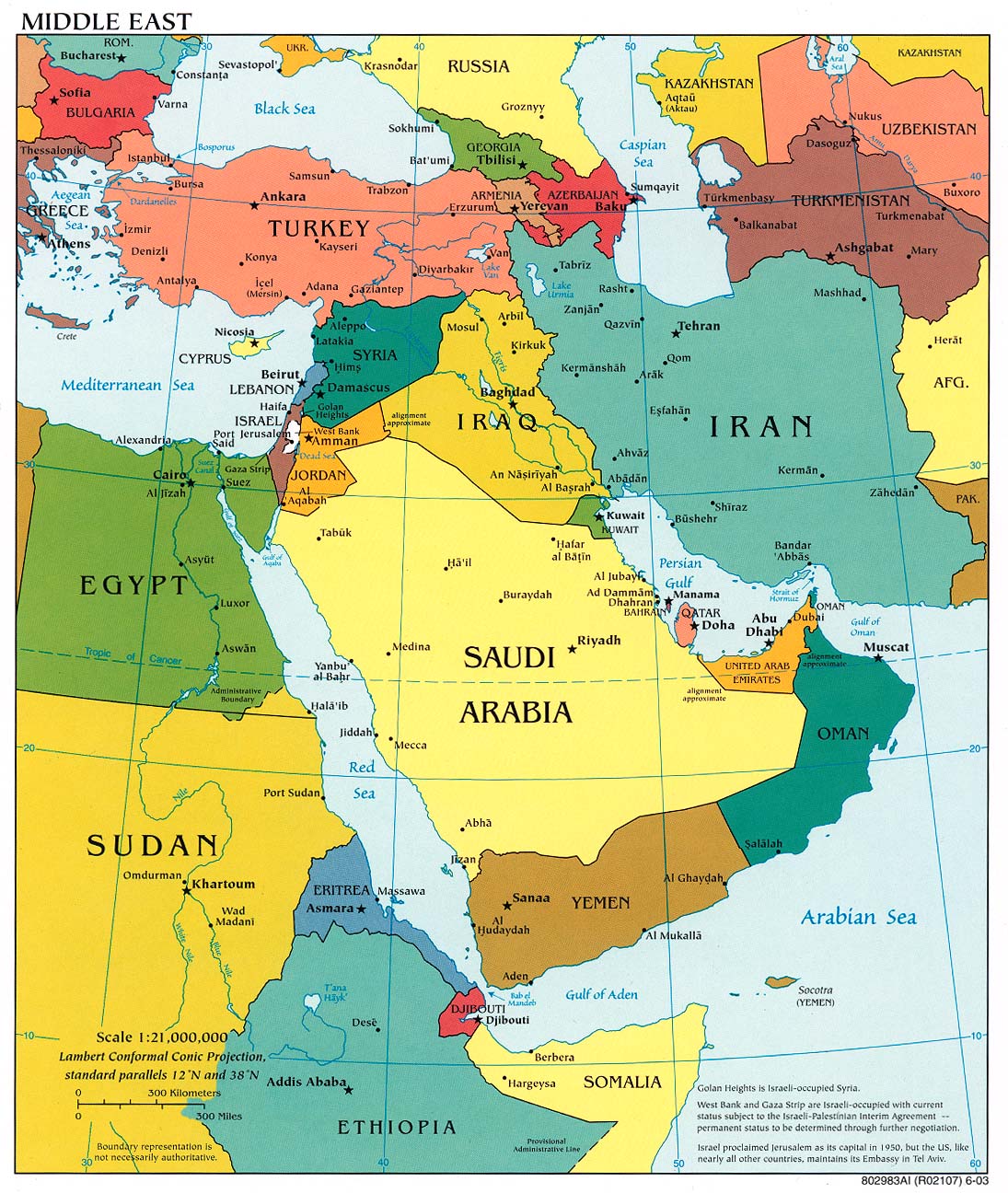
AN Iranian article claiming that the Arab Kingdom of Bahrain is Iranian territory has caused fury around the Arab world (Click here for a regional map of Bahrain). Hossein Shariatmadari, a close confidant of Iranian Supreme Leader Ayatollah Ali Khameini, wrote that "public demand in Bahrain is the reunification of this province with its motherland, the Islamic Iran." The foreign minister of Iran has since traveled to Bahrain in order to quell tensions.

Historically there has been friction between Iran, a Farsi-speaking majority Shi'ite state, and Bahrain, an Arabic-speaking Sunni-led country. In the 1970's Iran laid claim to Bahrain, but the then British protectorate instead voted for independence. In recent times, Arab states of the Persian Gulf and throughout the Mideast have looked at Iran's growing influence and nuclear program with suspicion.

Citizens of Bahrain have gathered in front of the Iranian embassy in protest. Furthermore Egypt, the most populous Arab state, has railed against Shariatmadari's statements. So has the chief of the Gulf Cooperation Council, of which Bahrain is a member along with Saudi Arabia, Kuwait, Oman, Qatar, and the United Arab Emirates.

Read More......

Saturday, July 14, 2007

Major Palestinian Terrorist Organizations

Below you will find a short description for the major Palestinian terrorist organizations

al-Aqsa Martyrs Brigades

Affiliation: Fatah; Popular Resistance Committee

Ideology: secular/nationalist

Base of Operations/Leadership: West Bank; Gaza

Brief History: First appeared in 2000, at the beginning of the Second (a.k.a. al-Aqsa) Intifada (uprising). Named after the al-Aqsa Mosque (a.k.a. the Dome of the Rock), which stands at an area that Jews call the Temple Mount (where the First and Second Temples existed in ancient Judea). Formed in reaction to then-Israeli opposition leader Ariel Sharon visiting the Temple Mount. Reportedly received payments from former Palestinian Authority Chairman Yasser Arafat. Is closely connected to Palestinian Authority ("PA") security services, and members likely still receive payments from current PA Chairman Mahmoud Abbas and his government.

Terrorist Incidents:

  • Jan. 2002 suicide bombing by female in Jerusalem that killed 1 and wounded 40
  • Mar. 2002 suicide bombing in Jerusalem cafe that killed 11 and wounded over 50
  • Nov. 2002 shooting at Israeli Kibbutz that killed 2 children, 3 adults, and wounded 7
  • Jan. 2003 suicide bombings in Tel Aviv that killed 23, wounded over 100
  • Jan. 2004 suicide bombing on a bus in Jerusalem that killed 11 and wounded 30
  • Mar. 2004 suicide bombing in Ashdod that killed 11
  • 78 separate rocket attacks between Apr. 2005 and Mar. 2007


Army of Islam

Affiliation: Popular Resistance Committee; influence by al-Qaeda

Ideology: Islamist

Base of Operations/Leadership: Gaza Strip

Brief History: First appeared in 2006. Leadership comes from the Dagmoush clan, a family in the Gaza Strip known for extortion, smuggling, and arms-dealing. Has variously coordinate and clashed with armed groups from Fatah and Hamas. Has demanded the release of leaders of al-Qaeda in return for freeing hostages.

Terrorist Incidents:
  • June 2006 kidnapping of Israeli Defense Forces Cpl. Gilad Shalit, killing 2 others
  • Mar. 2007 kidnapping of BBC Reporter Alan Johnston


Democratic Front for the Liberation of Palestine (DFLP)

Ideology: Secular/Marxist-Leninist

Base of Operations/Leadership: West Bank; Gaza Strip; Damascus, Syria

Brief History: The DFLP split from the Popular Front for the Liberation of Palestine ("PFLP") in 1969 over leadership dispute. Emphasizes international Marxism over Palestinian nationalism. Rejected the 1993 Oslo Accords with Israel, though has since accepted them.

Terrorist Incidents:
  • 1974 guerrilla attack of school in Ma'alot killing 27 (mostly children), wounding 134
  • 1977 bombings in Jerusalem and Tel Aviv
  • 1984 grenade attack in Jerusalem, wounding 21
  • 1985 bus attack near Hebron
  • 1988 gasoline bombing of the car of then-Industry and Trade Minister Ariel Sharon
  • Nov. 2006, fired 3 rockets in Israel, no casualties
Iz ad-Din al-Qassam Brigades

Affiliation: Hamas; Palestinian Resistance Committee

Ideology: Islamist

Base of Operations/Leadership: West Bank; Gaza Strip

Brief History: Established in 1987 as an offshoot of the Egyptian Muslim Brotherhood and as a major player in the First Intifada (uprising). Is dedicated to the destruction of Israel, and replacing it with an Islamic state. It's political wing, Hamas, initially refused to be part of the Palestinian Authority ("PA") because the PA was created after the 1993 Oslo Accords with Israel. Major player in the Second (Al-Aqsa) Intifada. Decided to participate in 2006 PA parliamentary elections, where it received a majority and formed a new government. Formed unity government with Fatah in early 2007 in attempt to end international boycott of PA. Ousted Fatah from Gaza Strip in June 2007 in violent military coup.

Terrorist Incidents:
  • Since 1993, various suicide bombings, rocket attacks, and small arms fire that have killed over 500.

Palestinian Islamic Jihad (PIJ)


Affiliation: Hezbollah; Iranian Revolutionary Guards

Ideology: Islamist

Base of Operations/Leadership: West Bank; Gaza Strip; Damascus, Syria; Lebanon

Brief History: Formed in late 1970's as an offshoot of the Egyptian Muslim Brotherhood. Believed the Brotherhood had become to moderate. Seeks the destruction of Israel and the replacement with a Mideast pan-Islamic empire. Even though it is a Sunni group, receives funding from Iran (a Shi'a country). Frequently coordinates attacks with Hamas.

Terrorist Incidents:
  • Since 1988, various shooting, suicide bombings, firebombings, rocket/missile attacks
  • Between May 2005 and Feb. 2007, responsible for 18 dead and 186 wounded
Popular Front for the Liberation of Palestine (PFLP)

Ideology: Secular/Nationalist/Marxist-Leninist

Base of Operations/Leadership: West Bank; Gaza Strip; Damascus, Syria

Brief History: Established in 1967 in response to failure of Arab countries to destroy Israel in Six Day War. Seeks to destroy Israel and replace it with Marxist-Leninist Arab state. Rejects the 1993 Oslo Accords and Palestinian Authority. Has received funding from Syria, Iran, and Libya. Pioneered airplane hijacking.

Terrorist Incidents:
  • 1968, hijacked El Al airplane.
  • 1972, shooting at Lod International Airport, killing at least 24
  • 1976, hijacked Air France Airplane, landing it in Entebbe, Uganda. In famous raid, IDF freed 100 hostages, though 3 died
  • 2001, shot dead Israeli Tourism Minister Rehavam Ze'evi
  • Between 2004 and 2005, responsible for at least 3 deaths and 30 wounded from rocket attacks and suicide bombings

Tanzim

Affiliation: Fatah

Ideology: Secular/Nationalist

Base of Operations/Leadership: West Bank

Brief History: Founded in 1995 in opposition to Islamist groups such as Hamas and Palestinian Islamic Jihad. Also, wanted to ensure that those who had stayed in the West Bank and Gaza after 1967 war maintained a voice in Fatah. Until 1993, Fatah leadership (i.e. Arafat and his associates) was based in Tunisia, and once they came back to the PA had not allowed the younger generation to gain positions of power. Tanzim sought to rectify this. Lead by Marwan Barghouti, who has been in an Israeli prison since 2002 for multiple murder convictions. Barghouti has negotiated several ceasefires between Palestinian factions and Israel, and considered a future contender for Chairman of the PA. There has been speculation that Israel may free Barghouti in order to boost PA Chairman Mahmoud Abbas' Fatah movement.

Terrorist Incidents:
  • Between 2000 and 2002, various shootings, stabbings, bombings, suicide bombings, and rocket attacks resulting in at least 26 dead and 100 wounded.


--References--

1976: Israelis Rescue Entebbe Hostages in BBC.com (available at http://news.bbc.co.uk/onthisday/hi/dates/stories/july/4/newsid_2786000/2786967.stm).

Council on Foreign Relations (available at http://www.cfr.org/index.html).

Demands issued on Johnston tape
in BBC.com (May 9, 2007) (available at http://news.bbc.co.uk/2/hi/middle_east/6637507.stm).

Yaakov Katz, Vilna'i: Let DFLP leader visit Ramallah in Jerusalem Post Online (July 13, 2007) (available at http://www.jpost.com/servlet/Satellite?cid=1184168556149&pagename
=JPost%2FJPArticle%2FShowFull).

Yaakov Katz, Sneh: Exchange Barghouti for Schalit in Jerusalem Post Online (July 10, 2007) (available at http://www.jpost.com/servlet/Satellite?c=JPArticle&cid=
1183980036224&pagename=JPost%2FJPArticle%2FShowFull).

Elise Labbot, Militants issue Israel hostage demands in CNN.com (June 26, 2006) (available at http://edition.cnn.com/2006/WORLD/meast/06/26/israel.soldier/index.html).

Paul Martin and Martin Fletcher, The moment of greatest danger in Times Online (June 18, 2007) (available at http://www.timesonline.co.uk/tol/news/world/middle_east/article1945825.ece).

MIPT Terrorism Knowledge Base (available at http://tkb.org/Home.jsp).

Aaron D. Pina, Palestinian Factions, Congressional Research Services Report RS 21235 (June 8, 2005) (available at http://www.fas.org/sgp/crs/mideast/index.html).

Profile: DFLP in BBC.com (Feb. 4, 2002) (available at http://news.bbc.co.uk/2/hi/middle_east/1800092.stm).

Statement of Indictment: Marwan bin Khatib Barghouti in Israel Ministry of Foreign Affairs (Aug. 14, 2002) (available at http://www.mfa.gov.il/MFA/MFAArchive/2000_2009
/2002/8/Marwan%20Barghouti%20Indictment%20-%20Appendix-%20Terrorist).

Weapon Survey (available at http://www.weaponsurvey.com/).

World Incidents Tracking System (available at http://wits.nctc.gov/Main.do).

Read More......

Thursday, July 5, 2007

Hamas and the Army of Islam

Alan Johnston, the BBC reporter captured by a little known terrorist group called the "Army of Islam" four months ago, was finally freed yesterday. Upon his release, Johnston stated that his captors were "just cruising along" under the Fatah security regime, but there was a palpable fear once Hamas' Gaza military coup. Johnston said, "If Hamas didn't come in and put the heat on, I'm pretty sure I'd still be there."

Here is a summary of the events leading up to his release:

On June 15th, after Hamas conquered the Gaza Strip, its leaders announced that one of its priorities was the release of Johnston.

On June 24th, the Army of Islam (Jaish al-Islam in Arabic) released the following video of Alan Johnston, which shows him in a suicide vest. Johnston pleads for his life, and warns that if Hamas or any other entity attempted to free him by force, the Army of Islam would detonate him.


On July 2nd, Hamas seized several members of the Army of Islam including Khattab al-Maqdisi, the spokesman of the group. Hamas accused al-Maqdisi of opening fire on Hamas security forces.

On July 3rd, hundreds of Hamas gunmen gathered around the area where Johnston was held. Hamas snipers took positions on nearby rooftops and placed vehicles in the road to block off exits.

Early on July 4th, Hamas and the Army of Islam struck a deal and Johnston was released.

The details of the bargain to free Johnston are not clear, but one thing is for certain: the Army of Islam will not be immediately disarmed. A Hamas spokesman stated that the group may keep its weapons if it uses them "to be part of the resistance." In the parlance of Hamas,
that means attacking Israel.

But the main reason that Hamas cited the release of Johnston as a top priority was to gain international legitimacy. As I stated in a previous post, the release of Johnston was one of the steps Hamas must take in order to achieve legitimacy. But it must also maintain order. The Army of Islam is an al-Qaida inspired criminal organization lead by a powerful Gaza clan that has frequently clashed with Hamas, Fatah, and others. Hamas will not be able to preserve the peace if the Army of Islam is allowed to retain arms.

Furthermore, the mere suggestion of a tolerance for al-Qaida will drive off any international good will that Hamas received from securing the release of Johnston. When the Army of Islam kidnapped the BBC reporter, the group demanded that Britain exchange him for detained terror suspect Abu Qatada al-Filistini. The British accuse al-Filistini of mentoring 9/11 co-conspirator Zacarias Moussaoui as well as attempted "shoe-bomber" Richard Reid. In addition, sermons from al-Filistini were found among the possessions of 9/11 hijacker Mohammed Atta.

But even if the Army of Islam had no connections to al-Qaida and only aimed its weapons at Israel, Israel's responses to terrorist attacks would disrupt Hamas' attempts to establish order. Just as Islamic Jihad's incessant rocket fire into Israeli towns will prevent the residents of Gaza from living in peace, so will Israeli Defense Force reactions to attacks from the Army of Islam.

Hamas is making a deadly mistake in allowing the Army of Islam to retain its arms. Such a decision can only lead to further instability in--and international isolation of--the Gaza Strip.

Update 4/28/09
I am now an attorney at Richard J. Mockler, P.A. Visit us on the web at http://www.FamilyLawRights.com

Read More......

Tuesday, June 26, 2007

On Bolstering Abbas

In a historic meeting between the leaders of Israel, the Palestinian Authority, Jordan, and Egypt, Israeli Prime Minister Ehud Olmert has promised to transfer $35o million to Palestinian Authority President Mahmoud Abbas. He also promised to release 250 Palestinian prisoners as a show of good faith. This announcement comes shortly after the United States and the European Union decided to lift the economic embargo against the Palestinian Authority, a result of Abbas sacking the Hamas government.

King Abdullah of Jordan and Egyptian President Hosni Mubarak voiced their support for Abbas. The Quartet of Middle East Mediators (the U.S., U.N., E.U., and Russia) met today in Jerusalem, suggesting that they believe Israel can work with Abbas as a partner for peace. The Quartet has not quashed rumors that outgoing British Prime Minister Tony Blair will be its new envoy, further suggesting the group sees new momemtum for a peace process.

So is all of this faith that the international community (including Israel) has in Abbas misplaced? In previous posts (From the Horse's Mouth, They're Wrong) I have written how Abbas and his Fatah party are just as bad, if not worse, than Hamas because Abbas says all the right things but has no power or will to implement hard decisions. He gives hope to the Israelis, Palestinians, and international community yet always disappoints, leading to dispair and worse violence.

But shouldn't Israel and the international community at least try to work towards a peace settlement with Abbas, the "voice of moderation?" My mind and my gut says absolutely not, but the remnants of my bleeding heart liberalism past says perhaps. However, there must be strict monitering of any money, weapons, or prisoners released to Abbas & Fatah. Furthermore, Abbas & Fatah must meet certain benchmarks in order to show that they are truly partners. These include:

  • Disbanding and disarming all non-state militias, including Fatah-related militias such as the al-Aqsa Martyrs Brigade and Tanzim.
  • Creating and enforcing a zero tolerance policy for crime and corruption.
  • Ending all media incitement against Israel.
Once Abbas takes these steps, he will have proven that he is willing to make and implement difficult decisions. Only then can Israel and the international community take any further actions to bolster Abbas and work toward peace and a Palestinian state. If Abbas fails to take these steps, which he likely will, then Israel and all those who desire for peace must look for a different path.

Read More......

Saturday, June 23, 2007

If Hamas Wants a Voice...

Daniel GP wrote in a comment to a recent post:


Pres. Bush praises Abu Mazen [a.k.a. Palestinian Authority President Mahmoud Abbas] as a "voice that is a reasonable voice amongst the extremists". But what's the use of a voice in Gaza these days? We need to see results. A Fatah-led government unable or unwilling to stop Palestinian terrorism brings us no closer to peace than does a terrorist Hamas government.
Hamas must now take steps to ensure that it's voice is considered legitimate in the international community and to bring about a better situation for the Palestinians of Gaza. The immediate actions it must take is to enforce order in Gaza, release BBC reporter Alan Johnston, cease all rocket fire from the Gaza Strip into Israel, and release Israeli Defense Force ("IDF") Cpl. Gilad Shalit.

Order

Hamas has already taken a step in the imposition of order in the Gaza Strip by beginning to collect unauthorized weapons. Though after Abbas became the leader of the Palestinian Authority he had promised to maintain "one law, one authority, one gun," he consistently failed to implement that policy. He had not wanted to use force against Palestinians, nor did he want to provoke a civil war. His inaction led exactly to the scenario that he had feared, and thus Hamas is now in charge of Gaza. And Hamas has no qualms about using force to compel compliance with its decisions.

Gaza has been a cesspool of chaos and violence ever since former Israeli Prime Minister Ariel Sharon decided to unilaterally pull the Israeli Defense Forces out of the territory. The Palestinians want rule of law, and Hamas can and will enforce order. Once the chaos has ended, the Palestinians of Gaza can speak to the international community in one voice.

Alan Johnston

BBC reporter Alan Johnston was abducted from the Gaza Strip on March 12, 2007. Many foreign journalists had been kidnapped from Gaza in the past, though they were usually returned within a few days. At this point, Johnston has been in captivity for over 100 days, the most time of any of the kidnap victims.

Johnston's abduction has caused the largest international outcry amongst governments and journalists against the Palestinians. Sure, Israelis have been kidnapped, wounded, and brutally murdered, but the international community has taken issue with this incident.

Since conquering Gaza, Hamas has said that it is working to release Johnston. If it succeeds and Johnston is returned alive and unharmed, Hamas will be sending a signal to the world that it respects at least some principles of international behavior.

Stopping the Rockets

Since Israel pulled out of Gaza, Palestinian terrorist groups (including Fatah, Hamas, and Islamic Jihad) have increasingly used Qassam rockets to shell nearby Israeli towns. This has continued under the new Hamas regime. If Hamas wants to avert a humanitarian disaster in the Gaza Strip, it will need Israel's cooperation to bring in food, water, and electricity. And to ensure this cooperation, Hamas must end all Qassam attacks.

Gilad Shalit

On June 25, 2006, several terrorist groups (including Hamas) broke through the border between Israel and Gaza, killed several Israeli soldiers, and kidnapped IDF Cpl. Gilad Shalit. Hamas has not allowed the International Red Cross to visit Shalit, nor has it given any sign of life. The group maintains, however, that Shalit is alive and well.

Almost all Jewish Israelis are required to serve in the IDF. Thus Israelis quite literally view IDF soldiers as their fathers, brothers, sisters, sons and daughters. They are appalled and distressed when any IDF soldier is kidnapped. The capture of Shalit is an especially emotional issue in their conflict with the Palestinians.

The unilateral release of Shalit will instantly change Israelis' view of Hamas. It will prompt an easing of tensions between the two sides, alleviate the suffering of Palestinians in Gaza, and spur a new hope that peace can be achieved with the Islamist group.

If Hamas releases Shalit, as well as restores order, releases Alan Johnston, and halts rocket fire, Hamas will show that it is an organization that can be dealt with. It will be a voice that Israel and the international community will not only be willing, but excited, to listen to.

Read More......

Wednesday, June 20, 2007

From the Horse's Mouth: They're Terrorists

Palestinian Authority President Mahmoud Abbas has finally come to the obvious conclusion: Hamas is a terrorist organization. Specifically, he said that members of this Palestinian Islamist party are "murderous terrorists." This should not be a radical statement, considering that (according to the Council on Foreign Relations) the group has killed over 500 people since 1993 using tactics including short-range rockets, small arms fire, and suicide bombings. Many, if not most, of the victims were innocent civilians. But it took the humiliation of Abbas' Fatah party in Gaza for him to finally see the light.

But, as I wrote in a previous posting, Abbas' party is no better. In fact, it may even be worse. With governments all over the world committed to Abbas' "moderate ideology," they continue to overlook the fact that Fatah does not have the discipline to commit its members, let alone non-Fatah Palestinians, to any peace settlement. Simply put, any agreement signed by Abbas wouldn't be worth the paper it's written on. And it is exactly this faux-agreement the global powers are pushing for.

It's no coincidence that Fatah was completely overpowered in the Gaza Strip. Even though Fatah had more gunmen, firepower, and Western-backing, Hamas had cohesion. They had the organization and common goals to forge ahead. This is why Hamas will eventually be the ruling power in all of the Palestinian territories.

Yes, Hamas is a terrorist group. And yes, Hamas (at least some parts) is committed to Israel's destruction. But they will see in their governance of Gaza that they have to deal with Israel, or else their "constituents" will die. They will have no food, water, or electricity, unless at least some coordination is made with the Jewish State. This may lead the way to future understandings, and possibly to a future peace deal, which they would have the power to enforce.

Richard Nixon opened relations with China. Menachem Begin signed an accord with Egypt. Hamas could be the key to peace with the Palestinians.

Read More......

Sunday, June 17, 2007

They're Wrong-A Different View of Hamas' Conquest of the Gaza Strip

For an overview of recent events in the Gaza strip, click here.

Most analysis (i.e. this one from the Jerusalem Post) on Hamas' recent conquest of the Gaza Strip has focussed on the fact that, since Palestinian Authority ("PA") President Mahmoud Abbas sacked the Hamas government, international aid will once again flow to the PA. This will strengthen the moderate tendencies of Abbas and his Fatah party, the thinking goes, and eventually lead to a peace settlement between Israel and the Palestinians in the West Bank. There will be glaring differences between the situations in the West Bank and the Gaza Strip. The Palestinians in Gaza, under the harsh rule of Hamas and its thugs and starved of international aid and sympathy, will overthrow the "Islamic Resistance Movement" and reunite with their West Bank brethren, coming under the umbrella of the peace settlement.

This analysis has several faulty assumptions. Number one is that Fatah is a moderate party. Yes, the party may be secular rather than fundamental Islamist, but via its militias Fatah has committed heinous crimes and terrorist acts against Israel. One of those militias is the Al-Aqsa Martyr's Brigade. According to the Council on Foreign Relations, between 2002-2005 they have been responsible for terrorist attacks resulting in the death of at least 77 Israelis and countless wounded. Their tactics include shooting sprees, sniper attacks, and suicide bombings. The Brigade has often utilized teenagers and women to perpetrate these attacks. More recently (a week ago), the Brigade broke through the barrier between Gaza and Israel in a TV truck in an attempt to kidnap Israeli soldiers.

The second faulty assumption is that Abbas has any control over what happens on the ground in the West Bank. Ever since Abbas came to power in 2005, all of the Palestinian territories have descended into complete chaos and all of the promises & attempts to bring the PA under "one gun" have failed. There is nothing to suggest that this situation will change any time soon, or that members of his own party will abide by any agreement Abbas makes with Israel.

The third misconception is that Palestinians will rebel against Hamas rule in the Gaza Strip. Hamas will be able to impose something that has been desperately lacking: order. The group has already taken a step that both Abbas and Yasser Arafat were afraid to; they have started confiscating illegal guns. Unfortunately for Israel, Hamas' concept of "illegal" guns are any guns not used to attack the Jewish State. Nonetheless, Palestinians in the Gaza Strip will welcome a new sense of safety and those that do not will lack the weapons to take a stand. In addition, Hamas will continue to get funds for social services from Iran, and the European Union--which has been divided on the economic blockade against Hamas from the beginning--will likely resume aid to the Gaza Strip in the near future.

The difference between the situations in the West Bank & Gaza Strip will indeed be glaring, but not in the way that most analysts currently contend. The West Bank will continue to be chaotic with roaming gangs of gunmen, while the Gaza Strip will be relatively quiet and peaceful. Consequently, Hamas will gain popularity in the West Bank and lead a similar coup in that territory.

The question is whether Israel will be able to take advantage of this scenario. But that is for another posting...

Read More......